
OXVA warranty and support questions answered clearly
Most people land here because a device has stopped behaving and they want to know one thing: is this covered, and who do I talk to? The short answer is that OXVA gives every product a 3 month warranty from the day it is delivered, and your first call is normally the shop you bought it from.
This page walks through what the warranty actually covers, what it does not, how a claim works in practice, and the quick checks worth doing before you start one.
Keep your order confirmation. Every warranty route, whether through the shop or through OXVA directly, starts with your order number.
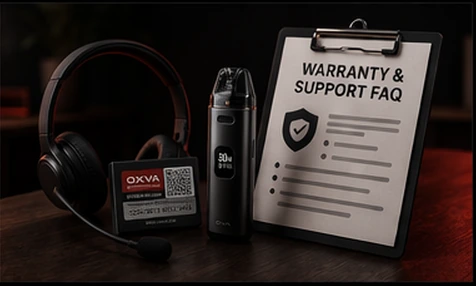
- Knowing what the 3 month warranty covers
- Claiming through your shop or OXVA
- Where pods and coils stand
- Your UK consumer rights on top
Quick answer: how the OXVA warranty works
If you just want the short version, these four points cover most situations.
3 months, from delivery
OXVA's published policy covers all items for 3 months, counted from the day the order arrives, not the day you first use it.
Faults, not accidents
Mechanical and electrical faults are covered. Drops, liquid damage, misuse and general wear are not.
Retailer first
Bought from a UK shop? Contact them first with your order number. UK consumer law gives you strong rights through the retailer.
Consumables sit outside
Opened pods, cartridges and coils are non-returnable for hygiene reasons. Faulty on arrival is different: raise that immediately.
What is covered and what is not
The line OXVA draws is the same one most hardware brands use: faults in the product are covered, everything that happens to the product afterwards is not.
Covered within the 3 months
- Devices that stop charging or powering on under normal use
- Buttons, screens or airflow controls that fail
- Charging ports and batteries with genuine defects
- Manufacturing faults present when the product arrived
- Items dead on arrival, which your shop should swap quickly
Not covered
- Damage from drops, liquid ingress or misuse
- Opening, cracking or modifying the hardware, which voids the warranty
- Cosmetic wear such as scratches and worn paint
- Opened or used pods, cartridges, coils and other consumables
- Products bought from sellers who cannot show they are legitimate
How a claim actually works
There are two routes, and it is worth using them in this order.
1. Go back to the shop
Contact the retailer you bought from with your order number and a short description of the fault. Under the Consumer Rights Act 2015 you can usually reject a faulty product for a full refund within 30 days, and you keep repair or replacement rights after that.
2. Claim direct with OXVA
If the shop cannot resolve it, email support@oxva.com with your order number, the product serial number, and clear photos or a short video of the fault. Verification normally takes 2 to 3 days and you usually do not need to post the faulty item anywhere.
3. Unopened returns
Changed your mind? OXVA's own store accepts unopened, unused items back within 15 days of purchase. For UK shop purchases, the retailer's returns policy applies instead, so check it before you buy.
Do these checks before you claim
A surprising share of warranty claims are not hardware faults at all. Five minutes here can save you a week of back and forth.
Rule out the usual suspects
- Charge for 30 minutes on a known good cable and adapter
- Check the device is not locked: most OXVA kits lock with 3 or 5 clicks
- Clean the pod contacts and reseat the pod firmly
- Try a fresh pod: a spent coil mimics a dead device
- Check the LED pattern against your device manual
Where to go from here
Depending on what you found, one of these three pages is the right next step.
Check your OXVA is genuine
Warranty support assumes a genuine product. If anything about the packaging or codes feels off, verify it before you claim.
Fix it instead
If the fault looks like a pod or settings issue rather than hardware, the troubleshooting hub usually gets you running again today.
Out of warranty and truly done?
If the device is past its warranty and genuinely finished, see what currently replaces it before spending anything on repairs.
Common questions about the OXVA warranty
Quick answers to the things people ask most before and during a claim.
How long is the OXVA warranty?
3 months on all items, counted from the day the order is delivered. Your retailer's returns policy and UK consumer rights apply on top of this.
Are pods and coils covered?
No. Once opened or used, pods, cartridges and coils are non-returnable for hygiene reasons. If one arrives faulty out of the box, raise it with your shop straight away.
Do I claim through the shop or through OXVA?
Shop first, with your order number. If they cannot resolve it, email support@oxva.com with your order number, serial number and fault photos. Verification usually takes 2 to 3 days.
Does it cover accidental damage?
No. Drops, liquid damage and misuse are excluded, and opening or modifying the hardware voids the warranty entirely.
What UK consumer rights do I have on top?
The Consumer Rights Act 2015 lets you reject a faulty product for a full refund within 30 days of purchase from a UK retailer, with repair and replacement rights after that. These sit alongside the manufacturer warranty.
What should I check before claiming?
Charge properly, unlock the device, clean the contacts and try a fresh pod. A large share of dead device reports are a spent pod or a locked device, not a fault.
Order number, serial number, photos
That is the whole formula. Rule out the quick fixes, gather those three things, and start with the shop you bought from. Genuine faults inside 3 months get replaced with very little friction.
STILL HAVE A QUESTION?
Our community is active in the Manuals & Warranty Forum - get a real answer from real OXVA users.
Current OXVA range at Vapestore UK
If your device needs replacing, the full OXVA range is available at the official UK stockist. 18+ only.